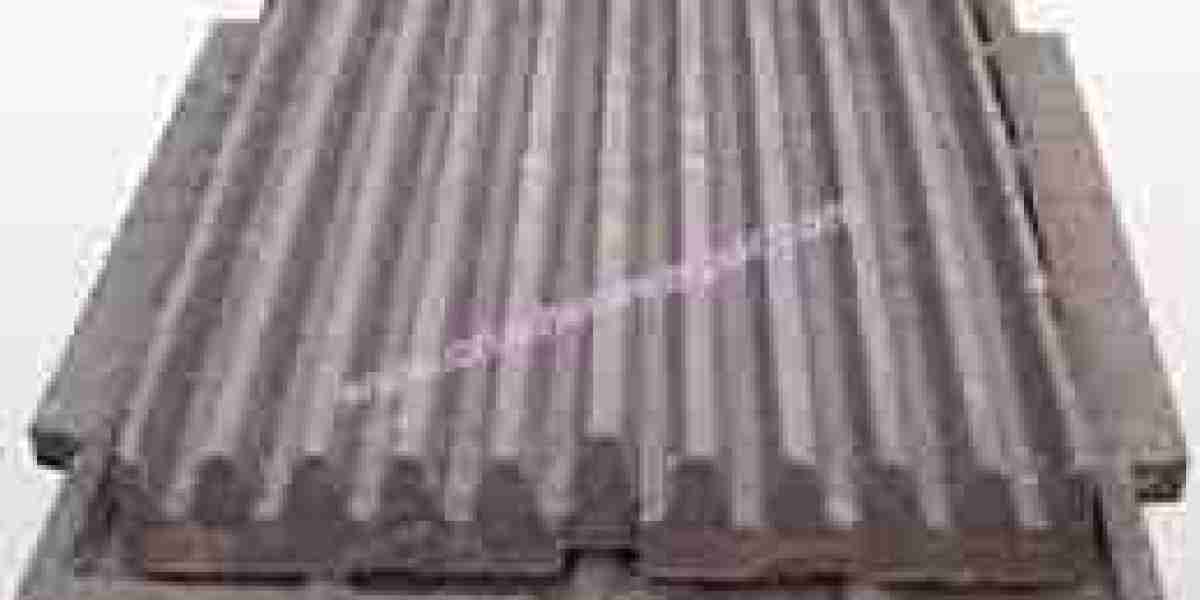

A Crusher Toothed Plate operates in an environment few people examine closely. Rock slides against steel. Compression cycles repeat thousands of times per hour. Engineers design these plates for dry abrasion. But feed material rarely arrives bone dry. Moisture enters the chamber with every load. Water changes the fatigue behavior of the plate surface. How can a liquid accelerate metal failure in a crushing zone built for compressive strength?
Fatigue begins at microscopic scale. Each compression cycle puts tension on the plate's surface layer. Dry rock creates pure abrasive wear. Material removes slowly from the tooth tips. Wet rock introduces a different mechanism. Water penetrates existing micro-cracks on the plate surface. During the compression stroke, water trapped inside a crack cannot escape. Hydraulic pressure pushes against the crack walls from within. This internal pressure extends the crack farther than dry cycling alone. Crusherwearpar field studies link wet feed directly to shorter fatigue life on jaw plates.
The acceleration follows a clear sequence. First, feed moisture above five percent allows water to reach fresh steel surfaces exposed by abrasion. Second, each crushing cycle forces water into those microscopic openings. Third, the compressive load of rock against plate seals the crack entrance temporarily. Water becomes trapped. When the jaw opens for the next cycle, pressure drops inside the crack. Trapped water expands. That expansion wedges the crack open further. Repeat this process thousands of times per hour. A crack that would take weeks to grow in dry conditions propagates in days under wet feed.
Some operators assume moisture slows wear by lubricating the interface. This assumption holds true only for very specific conditions. Sticky, wet clay does coat the plate surface. That coating reduces direct rock-to-steel contact. Abrasion slows. However, fatigue does not stop. The trapped moisture still attacks any existing micro-fracture. A plate under clay coating may look fine on the surface while crack networks develop underneath. When a tooth finally breaks away, the failure appears sudden. The truth involves weeks of hidden crack growth accelerated by moisture.
LinChuan examines this difference through controlled testing. Dry abrasion produces uniform material removal across the plate face. Wet fatigue produces localized cracking near stress concentration points. The tooth root and the mounting hole edges show first signs. Water collects in these low-energy zones during chamber draining. Each compression cycle drives water into the same weak points. Crack initiation occurs early. Crack propagation happens fast. The result is a Crusher Toothed Plate that loses whole sections rather than wearing down gradually. This failure mode costs more than scheduled replacement. Sudden tooth loss allows uncrushed material to pass through the chamber. That oversize material damages downstream equipment.
Site records from sixty crushing operations show a consistent relationship. Operations with feed moisture above seven percent replace plate sets thirty to forty percent sooner than dry operations. The wet sites do not see uniform wear. They see crack-dominated failure. Replacing a plate due to cracks costs the same as replacing a plate due to abrasion. The difference lies in predictability. Dry wear follows a steady curve. Wet fatigue produces sudden failure without warning.
Prevention requires addressing moisture at the source or choosing a plate designed for wet conditions. LinChuan offers plate profiles with stress-relieving features at tooth roots. These features reduce the crack initiation sites where water collects. The company also recommends harder alloy grades that resist crack propagation once a crack starts. A harder surface does not eliminate water penetration, but it does slow the wedging effect of trapped moisture. Crusherwearpar rejects any design that places mounting holes in high-stress zones. Hole placement determines where water-driven cracks begin.
https://www.crusherwearpart.com/ provides application notes on matching plate metallurgy to actual feed moisture levels. The site avoids general recommendations. Each analysis starts with customer rock samples and moisture readings. LinChuan engineers calculate expected fatigue life under both dry and wet scenarios. The difference between those two numbers reveals the true cost of ignoring feed water. A plate that performs for two thousand hours in dry granite may fail at twelve hundred hours when moisture exceeds eight percent. The purchase price does not change. The cost per ton doubles.
Every crushing plant controls feed size, crusher speed, and closed side setting. Few plants control feed moisture with the same attention. Water enters the chamber through pit conditions, stockpile management, or conveyor wash systems. Once moisture reaches the plate, the fatigue process accelerates. No operator can see cracks forming beneath the surface. The only warning comes from premature tooth loss or unexpected plate fracture. LinChuan and Crusherwearpar build plates that respect water's role in fatigue. Why run a plate that hides its cracks until the tooth breaks off?