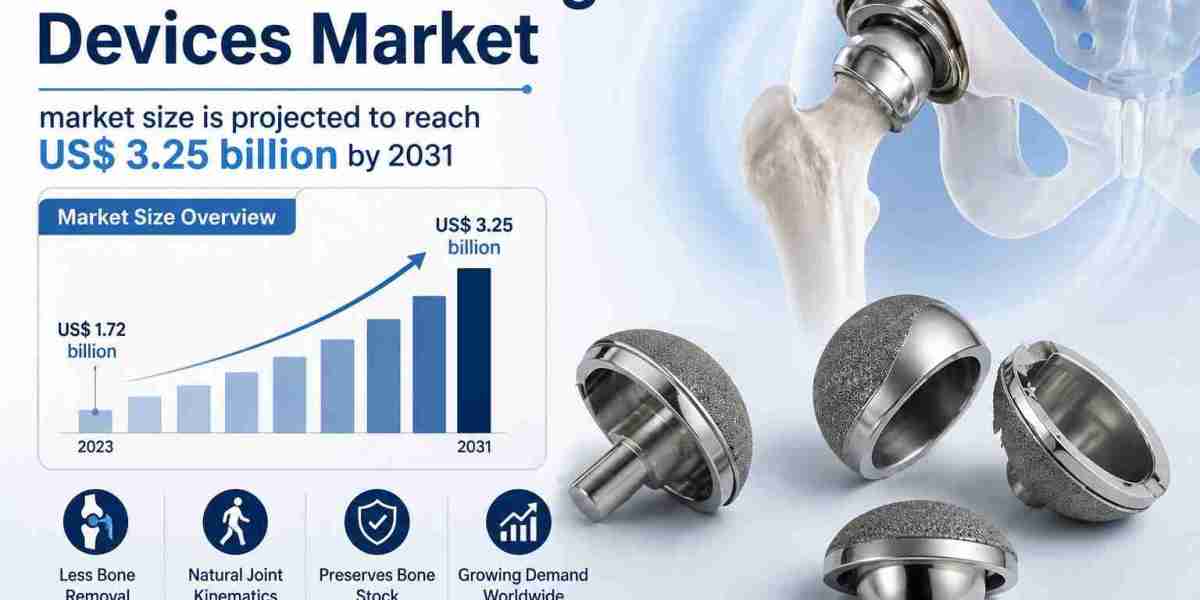

The joint resurfacing devices market is witnessing steady growth driven by the rising global burden of musculoskeletal disorders, particularly osteoarthritis, and the increasing demand for minimally invasive orthopedic procedures. Joint resurfacing has emerged as a preferred alternative to total joint replacement, especially among younger and active patients, as it preserves more bone and offers improved post-operative mobility. With technological advancements in implant materials and surgical precision, the market continues to expand across developed and emerging healthcare systems.
The Joint Resurfacing Devices Market Analysis highlights that the market is projected to grow from US$ 2.35 billion in 2024 to US$ 3.25 billion by 2031, registering a CAGR of 4.9% during 2025–2031. This growth trajectory reflects increasing adoption of bone-preserving procedures, continuous innovation in implant design, and a rising patient pool requiring joint repair solutions.
Market Overview
Joint resurfacing devices are specialized orthopedic implants designed to cap or resurface damaged joint surfaces rather than replace the entire joint. This approach helps maintain natural bone structure and reduces complications such as dislocation risks. The market is gaining traction due to its effectiveness in treating early-to-mid-stage joint degeneration, particularly in hip and knee applications.
The increasing prevalence of osteoarthritis, driven by aging populations, obesity, and sedentary lifestyles, is a primary growth driver. According to industry insights, millions of individuals worldwide suffer from joint-related disorders, significantly boosting the demand for advanced orthopedic interventions. Additionally, improved patient awareness and access to orthopedic care are contributing to the expansion of the joint resurfacing devices market globally.
Download Sample PDF: https://www.theinsightpartners.com/sample/TIPRE00041706
Market Dynamics and Key Drivers
Several factors are shaping the growth of the joint resurfacing devices market:
- Rising Geriatric Population: Aging populations are more susceptible to joint degeneration, increasing the demand for resurfacing procedures.
- Increasing Osteoarthritis Incidence: The global osteoarthritis epidemic continues to fuel the need for joint preservation solutions.
- Technological Advancements: Innovations such as 3D-printed implants, AI-assisted surgical planning, and advanced biomaterials are enhancing treatment outcomes.
- Minimally Invasive Techniques: Faster recovery times and reduced hospital stays are making resurfacing procedures more attractive to patients and healthcare providers.
Furthermore, the shift toward patient-specific implants and regenerative therapies, including stem cell integration, is opening new avenues for market growth.
Segmental Analysis
The joint resurfacing devices market is segmented based on type, material, end user, and geography.
- By Type: Knee, hip, shoulder, ankle, and others. The knee segment holds a significant share due to the high prevalence of knee osteoarthritis and the effectiveness of resurfacing in early-stage conditions.
- By Material: Metal, ceramic, and hybrid materials. Recent trends indicate a shift toward ceramic and advanced coatings to reduce wear and improve implant longevity.
- By End User: Hospitals, orthopedic clinics, and ambulatory surgical centers dominate the market due to increased surgical volumes and advanced infrastructure.
Knee and hip resurfacing procedures are particularly popular due to their ability to delay total joint replacement and provide better functional outcomes for active patients.
Regional Insights
Geographically, the joint resurfacing devices market demonstrates diverse growth patterns:
- North America: Holds the largest market share due to advanced healthcare infrastructure, high adoption of innovative technologies, and a large patient pool.
- Europe: Strong growth driven by government-supported healthcare systems and early adoption of orthopedic innovations.
- Asia Pacific: Expected to witness the fastest growth due to rising healthcare investments, increasing awareness, and expanding medical tourism.
- Middle East & Africa and South America: Emerging markets with growing healthcare access and rising demand for orthopedic procedures.
Competitive Landscape and Key Players
The joint resurfacing devices market is highly competitive, with several global and regional players focusing on innovation and strategic collaborations.
Key Players:
- Smith & Nephew
- DePuy Synthes (Johnson & Johnson)
- Zimmer Biomet
- Stryker
- Exactech
- Enovis
- MatOrtho Ltd.
- Medacta International
- MicroPort Scientific
- Corin Group
- Eska Implants
These companies are investing heavily in research and development to introduce next-generation implants, improve surgical outcomes, and expand their global footprint.
Emerging Trends and Opportunities
The joint resurfacing devices market is evolving rapidly with several emerging trends:
- AI and Robotics Integration: Enhancing surgical accuracy and reducing complications
- Personalized Implants: Custom-designed solutions using 3D printing technologies
- Regenerative Medicine: Combining resurfacing with biologics such as PRP and stem cells
- Outpatient Procedures: Increasing shift toward ambulatory surgical centers for cost-effective care
Additionally, the growing preference for bone-preserving techniques among younger patients is expected to significantly boost market demand in the coming years.
Future Outlook
The future outlook for the joint resurfacing devices market remains optimistic, supported by continuous technological advancements and increasing clinical adoption. The market is expected to benefit from:
- Expanding applications in early-stage joint disorders
- Development of durable and biocompatible implant materials
- Increasing healthcare expenditure in emerging economies
- Rising demand for minimally invasive and patient-centric treatment approaches
As innovation continues to address existing challenges such as implant longevity and surgical complexity, the joint resurfacing devices market is poised for sustained growth through 2031.
Related Reports:
Artificial Bone Market Size, Demand & Growth by 2034
Hip Replacement Implants Market Size, Share & Trends by 2034
Contact Us
Contact Person: Ankit Mathur
Phone: +1-646-491-9876
Email: sales@theinsightpartners.com
About Us
The Insight Partners is a leading provider of actionable market intelligence and consulting services across various industries. Our research reports combine advanced analytics, expert insights, and reliable data to help organizations identify new opportunities, optimize strategies, and achieve sustainable growth. We specialize in delivering in-depth market studies covering healthcare, technology, manufacturing, and emerging sectors.