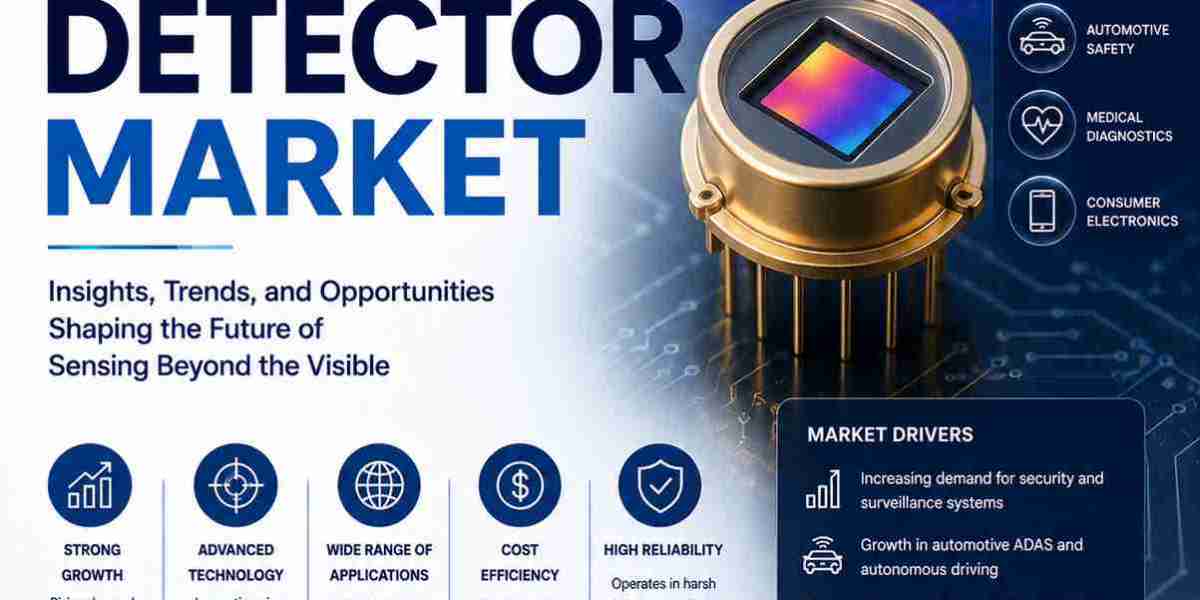

The Global Infrared Detector Market is witnessing strong growth as industries increasingly adopt thermal sensing, night vision, motion detection, environmental monitoring, and advanced imaging technologies across defense, automotive, healthcare, industrial automation, aerospace, consumer electronics, and security applications. Infrared detectors have become critical sensing components for modern surveillance systems, autonomous platforms, smart manufacturing environments, and next-generation electronic devices.
Infrared detectors are designed to sense infrared radiation emitted by objects and convert thermal energy into measurable electrical signals. These detectors enable temperature mapping, target identification, gas analysis, occupancy detection, thermal diagnostics, and imaging under low-light or zero-visibility conditions. As demand for non-contact sensing and intelligent monitoring systems accelerates globally, adoption of infrared detection technologies continues to expand rapidly.
The market is benefiting from increasing investments in border security modernization, thermal imaging systems, industrial predictive maintenance, smart automotive safety technologies, AI-powered surveillance infrastructure, and wearable sensing devices. Growing geopolitical tensions, rising automation levels, and expanding use of infrared sensing in commercial electronics are further strengthening long-term market growth prospects.
Modern infrared detectors are becoming more compact, energy-efficient, and highly sensitive due to advancements in semiconductor materials, microbolometer technology, quantum infrared photodetectors, MEMS engineering, and AI-based signal processing. These innovations are enabling broader deployment across both high-end military applications and cost-sensitive commercial markets.
Explore the full report here: https://www.strategicmarketresearch.com/market-report/infrared-detector-market
Market Overview
Infrared detectors are electronic sensing devices capable of detecting infrared radiation within various wavelength ranges including near-infrared (NIR), mid-wave infrared (MWIR), and long-wave infrared (LWIR). Depending on application requirements, detectors may be cooled or uncooled and can operate in imaging or non-imaging configurations.
The market includes technologies such as:
Thermal infrared detectors
Pyroelectric detectors
Mercury cadmium telluride (MCT) detectors
Indium gallium arsenide (InGaAs) detectors
Microbolometers
Quantum well infrared photodetectors (QWIP)
Photodiode infrared detectors
Thermopile detectors
Infrared detectors are widely integrated into thermal cameras, missile guidance systems, industrial monitoring equipment, gas analyzers, smart sensors, autonomous vehicles, fire detection systems, medical diagnostics equipment, and military surveillance platforms.
Key Market Drivers
1. Rising Demand for Thermal Imaging and Surveillance Systems
One of the major growth drivers for the infrared detector market is the increasing adoption of thermal imaging systems across military, commercial, and industrial sectors. Thermal imaging enables visibility in complete darkness, smoke, fog, dust, and harsh weather conditions, making it highly valuable for surveillance and threat detection applications.
Governments worldwide are investing heavily in advanced border monitoring systems, drone-based surveillance, night vision equipment, and smart defense technologies. Infrared detectors form the core sensing component of these systems, driving substantial market demand.
Commercial sectors are also adopting thermal imaging for perimeter security, public safety, infrastructure monitoring, and industrial diagnostics.
2. Expansion of Automotive Safety and Autonomous Technologies
The automotive industry is becoming an important growth engine for infrared detectors. Advanced driver assistance systems (ADAS), pedestrian detection systems, driver monitoring systems, and autonomous navigation platforms increasingly rely on thermal sensing technologies.
Infrared detectors help vehicles identify pedestrians, animals, and obstacles under poor visibility conditions, significantly improving road safety. As autonomous and semi-autonomous vehicles continue to evolve, demand for reliable infrared sensing technologies is expected to increase substantially.
3. Increasing Industrial Automation and Predictive Maintenance
Industrial facilities are increasingly deploying infrared detection systems for equipment monitoring, predictive maintenance, and energy efficiency optimization. Thermal sensors can identify abnormal heat patterns in machinery, electrical systems, motors, and pipelines before equipment failure occurs.
Manufacturers across oil & gas, chemicals, power generation, mining, semiconductors, and heavy engineering sectors are investing in infrared-based monitoring systems to reduce downtime, improve operational efficiency, and enhance worker safety.
4. Growing Adoption in Consumer Electronics
Consumer electronics manufacturers are integrating infrared sensing technologies into smartphones, wearables, smart home devices, gaming systems, and IoT-enabled electronics. Facial recognition systems, gesture recognition interfaces, occupancy sensing, and smart climate control systems are expanding the use of infrared detectors in mass-market applications.
The growing popularity of smart homes and connected devices is expected to create long-term opportunities for compact and low-power infrared detection technologies.
Market Restraints
1. High Cost of Advanced Infrared Detection Systems
Despite strong market potential, high manufacturing costs remain a major challenge, particularly for cooled infrared detectors and high-resolution thermal imaging systems. Advanced infrared materials and precision fabrication processes significantly increase production costs.
Military-grade infrared systems often require specialized cooling technologies, high-performance optics, and sophisticated signal processing systems, limiting affordability for some commercial users.
2. Technical Complexity and Calibration Challenges
Infrared detection systems require accurate calibration and precise thermal sensitivity to deliver reliable results. Environmental interference, temperature fluctuations, humidity, and optical contamination can affect performance accuracy.
Complex integration requirements and maintenance needs may restrict adoption among smaller organizations with limited technical expertise.
3. Supply Chain Constraints for Semiconductor Materials
The market depends heavily on specialized semiconductor materials such as indium antimonide, mercury cadmium telluride, and indium gallium arsenide. Supply chain disruptions, geopolitical trade restrictions, and limited availability of critical materials may affect manufacturing stability and pricing.
Emerging Opportunities
1. Expansion of Smart Cities and Intelligent Infrastructure
The growing development of smart cities is creating new opportunities for infrared detector deployment in traffic monitoring, smart lighting, occupancy sensing, public safety systems, and environmental monitoring applications.
Infrared sensing technologies can improve urban energy efficiency, security infrastructure, and intelligent transportation systems.
2. Increasing Use in Healthcare and Medical Diagnostics
Healthcare applications are emerging as a promising growth segment for infrared detectors. Thermal imaging is increasingly used for fever screening, vascular imaging, respiratory monitoring, cancer diagnostics research, and patient monitoring systems.
Non-contact infrared sensing gained considerable attention during global public health emergencies, accelerating adoption in hospitals, airports, workplaces, and public infrastructure.
3. Growth of Gas Detection and Environmental Monitoring
Infrared detectors are widely used in gas analyzers and environmental monitoring systems for detecting methane, carbon dioxide, hydrocarbons, and toxic industrial gases. Rising environmental regulations and industrial safety requirements are expected to support continued market expansion.
The increasing global focus on carbon monitoring and emissions reduction initiatives may further strengthen demand for infrared gas sensing technologies.
Market Forecast and Growth Trends
The infrared detector market is projected to witness robust growth over the next decade due to expanding defense modernization programs, industrial automation investments, smart vehicle development, and increasing thermal imaging adoption across commercial sectors.
Key market trends shaping future growth include:
Miniaturization of infrared sensing components
AI-enabled thermal analytics systems
Expansion of uncooled infrared detector technologies
Integration with IoT and edge computing platforms
Growth of compact thermal cameras for mobile devices
Increasing adoption in autonomous drones and robotics
Development of high-resolution infrared imaging systems
Advancements in low-power infrared sensors for wearable electronics
Asia-Pacific is expected to emerge as one of the fastest-growing regional markets due to expanding electronics manufacturing, rising defense spending, industrial automation growth, and increasing smart city investments in countries such as China, India, Japan, and South Korea.
North America continues to maintain strong market leadership due to extensive military investments, aerospace innovation, advanced semiconductor capabilities, and growing deployment of AI-driven surveillance technologies.
Europe is also witnessing significant growth driven by automotive innovation, industrial automation, environmental monitoring initiatives, and increasing focus on energy-efficient infrastructure.
Competitive Landscape
The infrared detector market is highly competitive and characterized by strong technological innovation, strategic partnerships, defense contracts, and continuous investments in advanced sensing technologies.
Major companies operating in the market are focusing on:
High-sensitivity detector development
Compact and lightweight sensor architectures
AI-integrated thermal imaging platforms
Expansion of uncooled infrared technologies
Semiconductor material innovation
Strategic acquisitions and partnerships
Advanced military imaging systems
Automotive infrared sensing integration
Leading market participants include:
Teledyne FLIR
Leonardo DRS
Lynred
Hamamatsu Photonics
Excelitas Technologies
Sofradir
BAE Systems
Raytheon Technologies
Seek Thermal
Xenics
Vigo System
Murata Manufacturing
InfraTec GmbH
New Imaging Technologies
Semi Conductor Devices (SCD)
Many companies are increasingly focusing on reducing detector costs while improving image resolution, sensitivity, durability, and power efficiency.
Latest Impact Analysis
Impact of AI and Edge Computing
Artificial intelligence and edge computing are significantly transforming infrared detection systems. AI-powered thermal analytics now enable automated anomaly detection, facial recognition, predictive maintenance, threat identification, and intelligent surveillance capabilities.
Edge processing is improving real-time decision-making while reducing cloud dependency and latency in mission-critical environments.
Defense Modernization Programs Accelerating Demand
Rising geopolitical instability and increasing military modernization programs are driving demand for advanced infrared imaging systems globally. Governments are investing in missile tracking systems, thermal targeting systems, reconnaissance drones, battlefield awareness platforms, and night vision technologies.
This trend is expected to remain a major long-term growth catalyst for infrared detector manufacturers.
Semiconductor Industry Advancements Improving Accessibility
Advancements in semiconductor fabrication and MEMS technologies are reducing production costs for uncooled infrared detectors. This is making thermal imaging solutions increasingly accessible for commercial and consumer applications.
As production scalability improves, infrared detectors are expected to penetrate broader markets including smart appliances, consumer electronics, and mobile devices.
Conclusion
The infrared detector market is evolving into a critical enabling technology for modern sensing, surveillance, industrial intelligence, and autonomous systems. Rapid advancements in thermal imaging, semiconductor materials, AI integration, and smart sensing architectures are significantly expanding the market’s commercial and industrial potential.
While challenges related to cost, technical complexity, and material supply chains remain, growing demand from defense, automotive, industrial automation, healthcare, and consumer electronics sectors is expected to sustain strong long-term growth momentum.
As industries increasingly prioritize intelligent monitoring, predictive analytics, and non-contact sensing capabilities, infrared detectors will continue to play a central role in the next generation of connected and autonomous technologies.