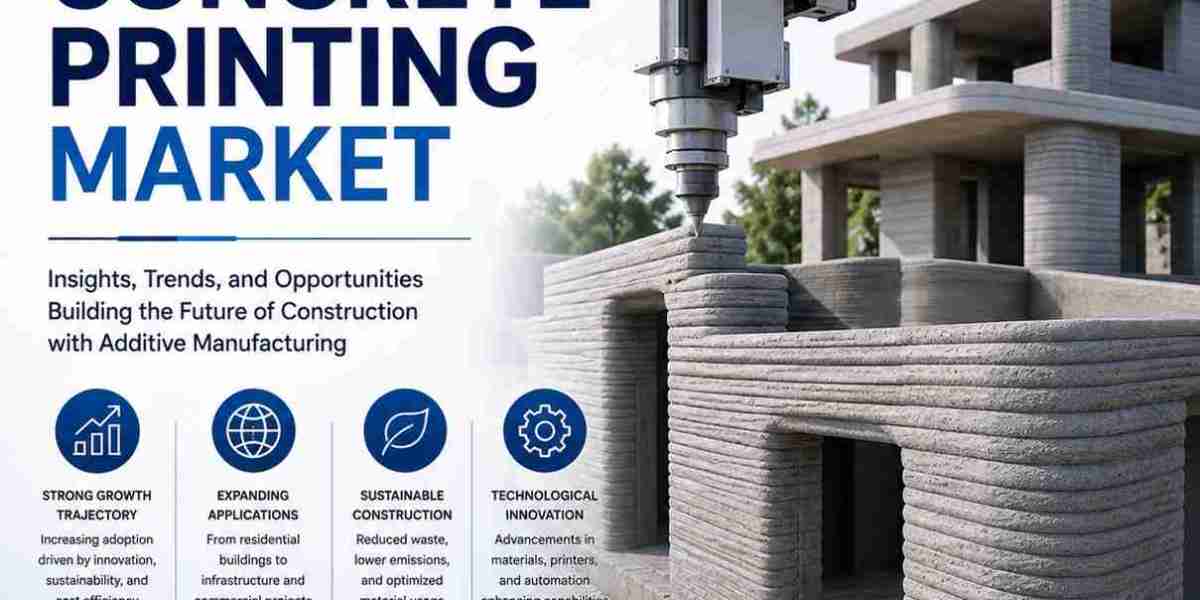

The global 3D concrete printing market is witnessing rapid expansion as construction companies, infrastructure developers, and governments increasingly adopt automated construction technologies to improve efficiency, reduce material waste, and address growing labor shortages. 3D concrete printing is emerging as a transformative solution capable of reshaping modern construction practices through faster project execution, lower operational costs, and enhanced architectural flexibility.
According to industry analysis, the Global 3D Concrete Printing Market is valued at USD 1.2 billion in 2024 and is projected to reach approximately USD 3.1 billion by 2030, growing at a CAGR of 17.3% during the forecast period. Market growth is being driven by rising demand for cost-efficient building methods, rapid adoption of digital construction technologies, increasing focus on sustainable infrastructure, and growing investments in smart city development.
3D concrete printing refers to an automated additive manufacturing process that uses robotic systems and specialized concrete mixtures to construct buildings and structural components layer by layer. The technology is increasingly utilized across residential housing, commercial buildings, industrial infrastructure, bridges, architectural structures, and disaster-relief construction projects.
Automated Construction Technologies Driving Market Growth
One of the primary factors fueling market expansion is the increasing adoption of automation across the global construction industry. Traditional construction methods often face challenges related to labor dependency, project delays, material wastage, and rising operational costs.
3D concrete printing addresses many of these challenges by enabling automated construction workflows capable of reducing labor requirements and improving construction speed. The technology can significantly shorten project timelines while minimizing human error and improving structural precision.
Construction companies are increasingly investing in robotic printing systems to improve productivity and maintain competitiveness in rapidly urbanizing markets. Large-scale infrastructure projects and affordable housing initiatives are also contributing to growing technology adoption.
Labor Shortages Supporting Industry Adoption
The global construction industry is facing increasing labor shortages, particularly in developed economies where aging workforces and declining skilled labor availability are affecting project execution capacity. 3D concrete printing offers a potential solution by automating complex building processes and reducing dependence on manual labor.
The ability to construct walls, facades, and structural components with minimal human intervention is becoming highly attractive for contractors seeking to improve operational efficiency. Governments and construction firms are increasingly exploring additive manufacturing technologies to address workforce limitations while improving construction scalability.
The technology is particularly valuable in remote or labor-constrained regions where traditional construction logistics remain challenging.
Sustainability and Waste Reduction Creating Major Opportunities
Sustainability is emerging as a major growth driver for the 3D concrete printing market. Traditional construction activities generate substantial material waste and carbon emissions, encouraging the industry to explore environmentally responsible alternatives.
3D concrete printing enables highly precise material deposition, significantly reducing concrete wastage compared to conventional construction techniques. The technology also supports optimized structural designs that minimize material usage while maintaining structural integrity.
Manufacturers and research organizations are increasingly developing sustainable printable concrete mixtures incorporating recycled aggregates, industrial byproducts, and low-carbon cement formulations. These innovations are supporting green building initiatives and climate-focused infrastructure development strategies worldwide.
In addition, 3D concrete printing is gaining attention for disaster-relief housing, emergency shelters, and affordable housing programs due to its ability to rapidly construct structures at lower costs.
Infrastructure Development and Smart Cities Supporting Expansion
Rapid urbanization and growing investments in smart city infrastructure are creating substantial opportunities for the 3D concrete printing industry. Governments worldwide are increasingly exploring automated construction technologies to accelerate urban infrastructure development while reducing project costs.
The technology is being evaluated for residential communities, pedestrian bridges, public infrastructure, modular housing systems, and urban landscape structures. Advanced architectural customization capabilities also make 3D printing highly attractive for modern urban design projects.
The growing integration of digital construction technologies, building information modeling (BIM), robotics, and AI-driven construction management systems is further accelerating market development.
Market Restraints and Industry Challenges
Despite strong growth potential, the 3D concrete printing market faces several operational and regulatory challenges. One of the key restraints is the relatively high initial investment required for industrial-scale printing equipment, robotic systems, and specialized material technologies.
Limited standardization and evolving building regulations may also slow large-scale commercialization in certain regions. Many countries still lack comprehensive regulatory frameworks governing printed concrete structures and structural certification procedures.
Technical limitations involving printable concrete consistency, reinforcement integration, and long-term structural durability remain ongoing areas of industry research. Additionally, large-scale deployment may require specialized operator training and advanced digital engineering expertise.
The availability and cost of suitable printable construction materials can also influence market adoption rates.
Technological Advancements Enhancing Market Competitiveness
Continuous advancements in robotics, material science, and digital construction technologies are significantly improving the capabilities of 3D concrete printing systems. Manufacturers are developing larger robotic printers, improved nozzle technologies, faster curing concrete formulations, and multi-material printing capabilities.
AI-powered construction automation, real-time quality monitoring, and integrated BIM systems are enhancing construction precision and operational efficiency. Researchers are also exploring autonomous mobile printing systems capable of operating directly on construction sites.
The integration of fiber-reinforced concrete mixtures, sustainable binders, and hybrid reinforcement systems is expected to further improve structural reliability and application flexibility.
Competitive Landscape Remains Innovation-Driven
The global 3D concrete printing market remains highly innovation-focused, with technology startups, construction firms, robotics companies, and material manufacturers competing to commercialize scalable additive construction solutions.
Companies are investing heavily in research partnerships, pilot projects, and strategic collaborations with governments, universities, and infrastructure developers. Product innovation, printing speed, material compatibility, and scalability remain key competitive differentiators.
The industry is also witnessing increasing venture capital investment and public-sector funding aimed at accelerating next-generation construction technologies and sustainable building initiatives.
Regional Market Trends
North America represents a significant market for 3D concrete printing due to strong technological innovation, increasing smart construction investments, and rising adoption of advanced manufacturing systems across the construction sector.
Europe maintains strong market growth supported by sustainability regulations, green construction initiatives, and government-backed innovation programs focused on low-carbon infrastructure development.
Asia Pacific is expected to emerge as the fastest-growing regional market during the forecast period. Rapid urbanization, population growth, affordable housing demand, and large-scale infrastructure investments across China, India, Southeast Asia, and the Middle East are significantly driving interest in automated construction technologies.
The Middle East is also becoming an important growth region as governments invest heavily in futuristic urban development projects and advanced construction automation systems.
Future Outlook
The future outlook for the 3D concrete printing market remains highly positive as construction industries worldwide increasingly prioritize automation, sustainability, and cost optimization. Continued advancements in robotic construction systems, printable materials, and digital engineering technologies are expected to accelerate commercial adoption across multiple construction segments.
Growing investments in affordable housing, smart cities, disaster-resilient infrastructure, and sustainable urban development are likely to support long-term market expansion. As regulatory frameworks mature and technology scalability improves, 3D concrete printing is expected to become an increasingly important component of next-generation global construction practices.